

SetSafe®: Control Strategy for Idle Fume Hood Management
Laboratory ventilation is a dominant energy load in research and healthcare buildings. Efforts to reduce energy often focus on room ventilation rates. However, fume hoods frequently limit how far air change rates (ACH) can be reduced due to their minimum airflow requirements. Even when not in use.

SetSafe® Idle Fume Hood Ventilation Management
Fume hood energy efficiency has historically involved a trade-off between safety and energy savings, often resulting in over-ventilated fume hoods during periods of non-use.

SetSafe® Case Study “Idle Fume Management”
Lab ventilation is one of the largest areas of energy use in lab buildings. It also poses the greatest opportunities for energy reduction and meeting sustainability goals.
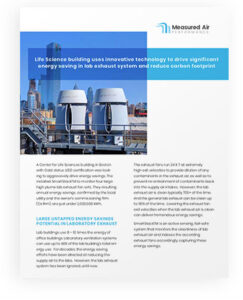
Life Science building drives significant energy saving in lab exhaust system with SmartStack™
A Life Science building in Boston with Gold status LEED certification was looking to aggressively drive energy savings. The installed SmartStack™ to monitor four large high plume lab exhaust fan sets. They resulting annual energy savings, confirmed by the local utility and the owner’s commissioning firm (Cx firm), are just under 2,000,000 kWh.

SmartStack® – Dramatic Energy Savings in Lab Exhaust Fans
SmartStack© is a proprietary, active sensing system that monitors lab exhaust air for 100’s of compounds. The system indexes the exit velocity of the lab exhaust fans based on the cleanliness of the lab exhaust air. It incorporates a patent-pending system that protects its sensors from over-exposure. This ensures reliability by significantly reducing sensor fouling and drift that normally occurs with exposure to high levels of contaminants, such as TVOC’s.
SmartStack® – Using Active Sensing to Safely Improve Lab Exhaust Efficiency
In most labs, there are typically only a few active fume hoods in the system emitting limited levels of contaminants. These contaminants are significantly diluted by the relatively clean air that is manifolded from other locations. Although, the laboratories operate in these relatively clean states for extended periods of time, the exhaust fan systems run at high exit velocities (e.g., 3,000 ft/min or higher). As a result, these systems frequently operate at much higher total flow rates than required using significantly more energy than necessary. Many assume that exhaust fans are required to operate at 3,000 ft/min (minimum).
